
Episode 3817 min
Intermittent Fasting For Building Muscle: My Opinion
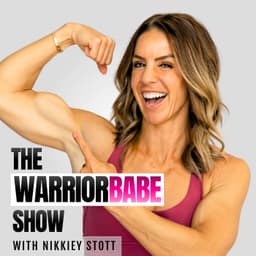
Listen to episode 38
Intermittent fasting is all the rage right now. But does it work for building muscle? In this podcast Nikkiey (@NikkieyStott), gives her honest opinion...
Full transcript
00:00Muscle is active tissue and it gets its energy from food. And you need food all throughout the day, especially pre and post-workout, to fuel your body and those processes to happen. What's up, you guys? Welcome back to The WarriorBabe Show with Nikkie Stott, co-founder of WarriorBabe. And on this podcast, we talk about mindset, methodologies, and tactics that will help you lose body fat, build muscle, be strong, and feel insanely confident.
00:30I am your host, Nikkie Stott, and welcome to episode number 38. And this is a listener Q&A inspired podcast. Again, I know on Monday I talked about traveling and all that jazz, which was inspired by a question too as well from you guys. This one was needed and bound to happen. So here we are today. It's all about intermittent fasting and building muscle. And so, I mean, you guys know, if you've been following me for a while, how I feel about IF.
01:08But I think we're going to turn a corner here today. Damn, this would be perfect for like April Fool's if I just went down that avenue for April Fool's with you guys saying that I was going to do it for intermittent fasting. That's not going to happen. But there is a way that if you do it right, it can be compatible with building muscle. And I'm going to talk about that a little bit later in the podcast. But first, I want to dish my opinion. You guys know my opinion. If you don't know my opinion, look, it's a tool to lose weight. But when it comes to building more muscle, aka what a lot of you women want that follow me and listen to this podcast, which is getting toned, you need to build more muscle in order to get toned.
01:46Okay, it's not a tool I'd recommend. Then, like I said, I'll share when it's done right, which I personally just don't think many people do it the right way. They just hear this like term that's thrown around and they see these people getting these results in X, Y, and Z. And so they try it. And it's like, I mean, there was this current video that just popped off. Was it Gwyneth Paltrow, I think, or someone? There was an actress that talked about it. And did she get a lot of backlash around it?
02:17But when it's done right, I'll talk about how it could help. Okay? Because I think, like I said, 90% of people I don't think do it right. They hear it, they try it, and then they want this result, but then they aren't doing it right. So they're not going to get that result. And look, that's that. But some more of my opinion, you fast while you sleep. Look, your metabolism never stops. It's always active. And so therefore, it's always going.
02:50And so it's always going while you sleep, which also involves so many other things while you're sleeping that help towards recovery. And you are technically in a fasted state that entire freaking time, you guys. So some of you guys sleep six hours. Some of you guys sleep eight hours. You're fasted during that time. Maybe some of you guys sleep eight hours, nine hours, and then maybe you don't eat right away. So therefore, you may be in a fasted state for like 10 freaking hours. Why do you need to do more than that? You know what I mean?
03:20Like, especially if your goal is to build muscle, to see the differences in your body composition, to have those visible changes. It's like muscle is active tissue, and it gets its energy from food. Okay? So like, there's that. If you didn't know that, now you know it. Muscle doesn't stop. Your metabolism doesn't stop. It needs energy. And it gets that energy in order to grow, in order to be recovered, all of the jazz from food. Okay? Plus, on top of that, there's some other things that happen.
03:54For you guys that are AM workout goers practicing IF, or you're not eating before you work out, you are lifting in a catabolic state. You're catabolic during your workout. So in layman terms, when you're in this state, your body is breaking down muscle and storing body fat for the production of energy to get you through that workout. That is completely kind of productive to the goals that you are working towards. You want to live in an anabolic state where you build and maintain muscle and burn away body fat.
04:28You get there by fueling your body properly with food pre and post-workout, and all throughout the entire day. Like I said, all the processes that go along with building muscle don't stop. They don't turn off. They're always active. They're always alive. And you need food all throughout the day, especially pre and post-workout, to fuel your body and those processes to happen. And I did a whole podcast on pre and post-workout.
05:00Don't know what episode it was. Don't know when it was. It was, I think, pretty recent. But definitely go check it out. And I actually speak to you guys who are morning workout people that don't eat before you work out. What a difference in endurance and strength that you're going to feel by fueling your body before you do work out. So that's a big one. You're in a catabolic state. You don't want to move in a catabolic state. You're in an anabolic state. Plus all the things that I just said with like, you fast when you sleep. Okay. And like, these things are kind of productive. Because the thing is, is like, and I told you, I'm going to talk about like, when you do it right, because these are a lot of the things that people do wrong.
05:35But when you do it right, then it can be compatible with building muscle. But the second thing that I do want to talk about is in lieu of like being catabolic, but also when this happens, cortisol gets elevated. So while you're living in this state, in a catabolic state, the main hormone is like elevated is cortisol. And cortisol is a fat storing hormone. Not to mention like all the other hormones that this can cause to get wacky. The more cortisol that you produce, the more pounds you can pack on.
06:07And especially you guys in your midsection. Okay. That if you're doing all of these things and you're not eating before you go work out and like six months down the road, you're wondering why you're not seeing the results that you want to see. Well, this could be a huge reason why. You're not feeling your body appropriately. So therefore, you're in a catabolic state. Your cortisol gets elevated. Cortisol is a fat storing hormone. And where do you think it's going to hold on to? Your abdomen. Okay. And then before I pivot into talking about like, you know, how they can be compatible together.
06:43Look, it's in my overall opinion, and this is my opinion. It's just not realistic if your goal is to build muscle tone up and to drop body fat. Because majority of you guys are doing it the wrong way. Okay. My the first couple of the catabolic sleeping, the cortisol being elevated are reasons enough to hold my opinion pretty strong. And like, again, like you technically intermittent fast while you're sleeping. But like I said earlier, I guess it's like more reliable that you put a name on it and push it publicly. Like, but again, it's like you got like a lot of people just see people doing it, gaining results from it.
07:17And then you Google search what is IF and it explains it, but doesn't give you all these tactics and things how to implement it the right way. It's like, oh, I have this window of I'm fasting for 16 hours. And this is what I do in that window of time. But I train before I work out or I train before this window, X, Y, and Z, like there's so many things out there. But I want for the sake of this podcast, on top of my opinion, to also give you the way to do it right. And how to make it compatible with building muscle. If you so want to seek out intermittent fasting for maybe to help you with any habits that you have when it comes to needing to make a better relationship with food,
07:57or you're doing it for health reasons, which are reasons why intermittent fasting is big is mainly for health reasons. But you do have this goal of building muscle. So I want you guys to know in the takeaway of this podcast to be able to walk away and be like, okay, I do this lifestyle. I already know that maybe I'm not doing it right. So now I'm going to leave this podcast today and I'm going to start doing it right. That's my whole good thing for you. I mean, if you guys jive with my whole opinion, then like just eat normally throughout the day.
08:28Please all throughout the day, pre-workout, post-workout, all throughout the day. Those mechanics and systems, hormones, everything that's related to building muscle don't stop. Your metabolism doesn't stop. Muscle tissue doesn't stop. It's all active. It needs energy. And to get that energy, it needs food. But like I mentioned at the beginning, you guys, it can be compatible. You just have to do it with these tactics that I'm about to share with you guys. So, hey, hey, just want to drop a huge appreciation to you guys listening to the show. It means a lot.
08:59I hope you guys are enjoying it and there's so much more to come with it. If you are enjoying it, hit the subscribe button. I'd appreciate that tons. And also, it would help this podcast reach others who need to hear these messages too. Thanks so much, guys. Let's get back to the show. To piggyback a little bit off of what I already spoke to about in my opinion, all the things that a lot of people do wrong, which is not eating while they're training or not giving their body enough protein, all of this stuff.
09:29Here are some supporting ways that you can make sure that you are doing that when you do or practice or implement IF into your routine. So when you're doing IF, obviously, it's a period of fasting. And during which in this period, there is limited nutrient availability. So this can make it super challenging to consume the necessary calories and macronutrients to support muscle growth. Think about it. If you're in this window of time that you're eating, are you, a lot of people, majority,
10:00are eating in a true, true, true, like not even a true deficit, like below a deficit. Like they're not eating enough. Yeah, they may have snacks in this window, but like, are you eating enough to support the goals of building muscle? Like in order to do that, an average number is like 2000 calories. Do you think, let me ask you, if you're practicing IF, do you think in that window of time, probably a handful of you guys will say yes, but probably majority of you will say no, that in that handful, in that timeframe, are you hitting 2000 calories?
10:31And are you eating enough protein to support all of the things that protein does? Which leads me into my second point, that intermittent fasting leads to a reduction in protein synthesis, which is the process of building new muscle tissue. So protein synthesis is the most active after consuming protein. So if protein intake is limited, muscle growth can be totally compromised, which again, a lot of people that practice IF do it for the reason of wanting to lose weight, right?
11:04And, or they're not eating enough protein. That's a big like epidemic in the industry is that people just don't know how to eat enough protein or what protein number they need to be hitting. And you need to be hitting at least like 0.7 to one gram of protein per body weight. So there's those two things like in that window of time, are you really eating enough because you need to be eating enough to support the muscle growth that you want to be having. So ask yourself, am I truly eating what I'm supposed to be eating?
11:351600 calories, 1800 calories, 2000 calories. And some of you may say yes, a handful, but majority of you're going to say no, because you're just eating snacks in this window. Because that's what a lot of people say to do with IF. And then are you eating enough protein? Protein is so important. Like I said, over and over and over again, it's so important to muscle growth, to muscle recovery, to all of the things that are going to help you to build more muscle and aka get toned. Now, the last one I want to touch on here for a tactical takeaway for you is when intermittent
12:11fasting is done wrong, increased muscle breakdown happens. So in order to do it right, fasting for extended periods of time are not necessary. Like people that do the 16 hours, I mean, in my opinion, you fast while you sleep, that's enough time. And that's doing those long periods of time can lead to muscle breakdown as a body lacks the source of energy that it needs in order to build muscle. So like I said, all of these things happen when it's done wrong, right?
12:41But when it's done right, it involves carefully planning your meals to ensure that you're getting adequate calorie and nutrient intake during this eating window, which I already alluded to like, make sure that you're planning your meals ahead of time, you're hitting the 1600, 1800, 200, 2000 calories, 2200, 2400, whatever it may be, that's sufficient for your goals. And it should be on the higher end because building muscle needs those calories and those macros. So you want to make sure you're carefully planning, are you hitting it in that window of time,
13:14prioritize your protein intake, limit the fasting periods to prevent the muscle breakdown. Like in my opinion, like I said, while you sleep is enough of a window to be fasted, to support this goal. Look, again, I spoke to it in the beginning. It's a tool for weight loss. If your jam is just to lose weight, then cool. Intermittent fasting may help you. I know it helped my dad. He did it. But then in previous podcasts, I've alluded to him like, yo, dad, you got to start strength training. You got to start building muscle. And that's another beast.
13:45So there's a difference between fat loss and weight loss. And I did that in an earlier, earlier, earlier podcast that you can definitely check out. And it will help you to provide some clarity here that where your goals should be. Because if your goals are to build muscle, it's a different beast than just trying to lose weight. Okay. So again, plan your meals ahead of time, prioritize protein intake, limit your fasting periods, but also to resistance training could also be done and should be done in the eating window to provide the body the necessary nutrients to support muscle growth.
14:20So my AM goers that work out and that practice IF, guys, in order to do it right and to make it compatible with building muscle, eat during the window time that you are eating. So make sure that you're providing your body the necessary nutrients to support muscle growth. If you guys could hear that Maverick just whined him. He's like, yo, mom, it's my time. But seriously, so those are ways you make it compatible is plan your meals ahead of time.
14:52Make sure you're getting the right calorie and nutrient intake during that eating window that like, cool, if you want to practice IF and you don't eat until 11am, but you're still hitting 2000 calories in your day. That's amazing. Make sure you're getting enough protein intake in that window too as well. And then this is the most important one, like resistance train during that eating window so that your body has all of the nutrients to support the muscle growth that you, that is your overall goal. That makes it productive towards the goals that you want to accomplish.
15:22But everything I mentioned along with my, in my opinion, being in a catabolic state, it's not supportive to the goals that you want. It's counterproductive to those goals that you want to have. And it makes all of these things get wacky inside of your body. And it's just, it's not realistic again to the goal building muscle. But if you're doing it the right way that I just alluded to, it can be compatible. But like I mentioned, majority of people do it the wrong way. So if you put all of these tactics and tips and tricks that I just mentioned into play, and you want to practice IF, have at it, go do it.
15:54Just do it the right way. Because that's how you'll get to the goals of what you're striving for. All right. I hope you guys enjoyed this one. Share this with a friend, please. And whoever you know that maybe wants to be toned, right? And build some muscle, but they're doing IF and they're probably doing the wrong way. Share this with them. Because that's all. And that's all I ask you guys do is like, take this knowledge I'm sharing with you guys here on this podcast and go give it to somebody else who needs to hear this. Okay. Thanks. I'll see you guys in the next one. Peace. Real quick.
16:24The only ask I could ever have of you guys is to help spread the word so we can help more women lose body fat, build muscle, reach their goals, and feel insanely confident. And the only way we can do that is if you rate, review, and share this podcast. So the single thing I ask for you to do is if you could leave a review. It will take you 10 seconds and it will mean the absolute world to me and may change the world of someone else.
This transcript was generated automatically and may contain errors.
Listen next
All episodes →Reverse Dieting: The Fix You Need to Make Fat Loss Actually Work
Episode 284 · Aug 11, 2025
Why a 1200-Calorie Diet Fails Women Over 40
With Dr. Stacy Sims
How To Get Ripped at 51 w/Alicia Erickson
Episode 221 · Jan 3, 2025
Free Body
Transformation Assessment