
Episode 31051 min
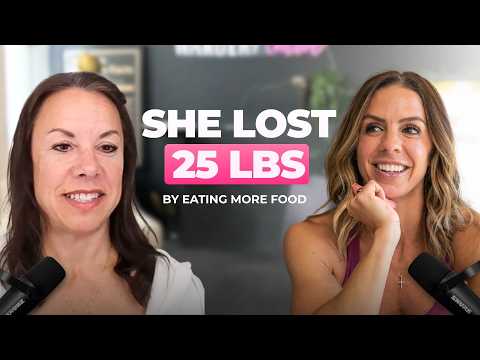
How to Lose Body Fat in Menopause by Eating More

Listen to episode 310
Chapters
In this episode
Amy spent years doing what so many women over 40 are told to do: eat 1200 calories, run miles a day, push through CrossFit soreness and hope the scale cooperates. She would hit a goal weight for a few days, then watch it creep back up, a little higher every time. By her early 50s she was in menopause, dealing with knee arthritis, joint pain, high blood pressure and cholesterol numbers that weren't moving, and she was starting to wonder whether this was simply what getting older looked like.
In this episode, Amy shares what happened when she joined WarriorBabe and her coach started her at 1400 calories with no running. She was nervous, but she decided to trust the process one day at a time. About five months in, real hunger signaled her first calorie bump. Today she is down more than 40 pounds to a weight she hadn't seen since high school, from a tight size 10 to about a 4, and she is maintaining while eating more. She no longer spends days unable to climb the stairs after a workout.
Amy also talks about how she paired coaching with a functional medicine doctor and her GYN, learned to ask better questions at appointments, and why the mindset calls she almost wanted to skip turned out to matter as much as the workouts and nutrition. Her message to anyone on the fence: be ready to listen, be ready to track, and then actually do the work.
Key takeaways
- Amy found that 1200 calories plus running five miles a day only produced short-lived weight loss, followed by hunger, snacking and weight creeping back higher each time.
- Alcohol is logged as calories but not macros in MyFitnessPal, so Amy learned those calories still have to come out of your carbs or fats.
- Carb quality matters: the carbs in a sweet potato are not the same as the carbs in a bagel or cookies, even if both fit your numbers.
- Amy started at 1400 calories with no running and stayed there about five months, until genuine hunger told her coach it was time for a calorie bump.
- Taking the process one day at a time kept Amy from panicking about eating more, instead of looking at it in month or year chunks.
- Being constantly sore isn't normal; in the episode's view, Amy's recovery improved once she gave her body enough nutrition.
- Going to appointments knowing what to ask, and explaining that what you feel is physical, helped Amy get the support she needed from her doctors during menopause.
- Having workouts and a plan doesn't produce results on its own; you have to log your food, do the workouts and work on your mindset.
Questions answered
Can you lose body fat after menopause?
Amy was officially in menopause when she started, and she lost over 40 pounds, went from a tight size 10 to about a size 4, and reduced her menopause symptoms through strength training, eating more and working with her doctors.
Why didn't eating 1200 calories work long term?
Amy said it wasn't sustainable. She would hit a goal weight for a couple of days, but eventually she got hungry living on 1200 calories and running five miles a day, and the weight crept back up higher each time.
Do alcohol calories count toward your macros?
Amy assumed alcohol was free because MyFitnessPal subtracted calories without touching her macros. She learned from the podcast that alcohol calories have to come out of your carbs or fats.
How long did it take to get a calorie increase at WarriorBabe?
Amy started at 1400 calories and stayed there about five months. Her coach kept checking her hunger and gave her a calorie bump once Amy started getting genuinely hungry.
Is it normal to be sore for days after every workout?
Amy used to think so after years of CrossFit, but since joining WarriorBabe she has had only two or three days of feeling she overdid it. The episode's view is that getting enough nutrition helped her muscles recover.
Full transcript
Amy: I was a really tight size 10, which probably should have been moved up to a 12, but I was trying not to. And I'm down to about a 4 now. I was on two blood pressure medications prior. Instead of 75 milligrams twice a day, I'm down to 25 milligrams twice a day. I was definitely feeling defeated, and I was starting to get a little scared that I didn't have a lot of time left on this earth if I didn't find a way to fix it.
Nikkiey: Hey, everybody. So today we have WarriorBabe Amy. Amy used to rely on cutting calories and ramping up cardio so that she could stay in shape. But when menopause hit, nothing was working the way that it used to. Joint pain, inflammation and exhaustion took over, and her usual approach wasn't getting her the results that she was hoping for.
Then she found WarriorBabe. And now she's going to share so many of her successes with us here today. She's lost over 40 pounds, she's reduced her menopause symptoms, and she feels stronger than ever. She's proof that you don't have to settle. You can take control of your health at any stage of life. Today, let's dive into her story. Amy, thanks for being here.
Amy: Hello. Thank you for having me.
Nikkiey: Can you let the listeners know where you are in the world, where you're from, how old you are and what you do for work?
Amy: I am in Rochester, New York. Beautiful, snowy Rochester, New York right now. I work at one of the local university hospitals, and I am in medical research. So mostly a desk job, but I am up and moving around the hospital quite a bit. So probably a 50-50 mix of desk and moving around. And I'm 54 years old. I'll be 54 next week, so I'm going to round up.
Nikkiey: Oh, happy early birthday.
Amy: Thank you.
Nikkiey: All right, so let's dive into it. Can you let everybody know what your health and fitness was like before you joined WarriorBabe?
Amy: Well, about a year ago now, I was obviously heavier. I was struggling with menopause symptoms. I was coming off of a knee injury, and I was just having a lot of joint problems. So the more I tried moving around, the more I was hurting. And I was starting to feel like, I guess this is it. You get old, and that's why people stop moving, because you can't move anymore. Part of me was feeling like you just have to eventually succumb to it. And the other part of me was like, but no, other people can move. There's got to be a way to stop feeling like this. So that's the weird struggle that I was in right before I found WarriorBabe.
Nikkiey: You didn't want to accept that that was your way forward, which I love, that mentality. How did those symptoms affect your daily life? Menopause, joint pain, and you mentioned too, when I was reading through your story beforehand, that you had high blood pressure.
Amy: I've had high blood pressure since I was 29 years old. I just have an awful family history of a lot of early heart disease and that type of thing. So I was used to dealing with the blood pressure, though in recent years it was definitely becoming something I was noticing more, because it's always deemed the silent killer, since you don't usually have a lot of symptoms. But I was definitely having more symptoms of palpitations and getting a little more short of breath moving around. I don't know if that was just the weight or the blood pressure or the combination of the two.
And cholesterol: my doctors already had me on an injectable medication, because the statins weren't working anymore, and the numbers still weren't coming down the way they really wanted them to. But I wasn't able to work out because my knees and my joints hurt. So I was caught in this negative cycle that was just not helping. My doctor finally sat down with me and said, listen, this is an expensive medication and insurance isn't going to keep paying for it. You have one more dose up that we can go to, and then that's it, you're maxed out, and they're going to take it away if it's not working. And I was like, oh geez, I can't just basically give up.
So that's where I was struggling. I've got to find something that's going to help me get this menopause under control, get the joint pain under control and get me moving again, so that my numbers can get in line and I can live.
Nikkiey: Would you say that was a specific moment or experience that made you realize something has to change?
Amy: That was one of my defining moments. All right, enough is enough. I've got to do something. I was spending a lot of time online looking at whether I needed a nutritionist, or what I needed. And for as much as it sucks that your privacy isn't really respected online, I think because I was searching so much of that, my Facebook feed started getting a lot of ads for different workout programs, and WarriorBabe was one of them. So I checked them out.
Nikkiey: So glad you did. Before we dive into what that Facebook ad said to you, and what specifically made you more intrigued by what WarriorBabe had to offer: how did dealing with those struggles make you feel physically and mentally?
Amy: I was feeling defeated, for sure. I did not like having the extra weight. I'd usually been pretty active before. I used to do CrossFit and I used to do a lot of other things, so I was used to being able to move around until I got that injury. And then I was doing running, and running didn't work for me, because I tried training up for a half marathon and gave myself double Achilles tendonitis. So that wasn't fun either. It was always, why does it always have to hurt? So I was definitely feeling defeated, and I was starting to get a little scared that I didn't have a lot of time left on this earth if I didn't find a way to fix it.
Nikkiey: You mentioned too, when I was reading what you wrote about your story, that you were sore for days after workouts as well. How did that impact your motivation to even want to show up?
Amy: Through CrossFit and stuff, I just kept going. I would go to the gym whether I was sore or not. It probably wasn't great for my body, but I did it, because I felt like exercise was important and it needed to be done. And I thought that's just how everybody is, maybe it just hurts and you just have to get used to hurting all the time. And then I'm finding out from people, no, you shouldn't be constantly sore. What are you doing? And I'm like, well, that's how my body always is. My joints always hurt. My muscles always hurt. But apparently that is not how it really has to be, because that's not how I've been living now.
Nikkiey: For the last almost year of WarriorBabe?
Amy: Yeah. I think I've probably had maybe two or three days where I was like, oh, I probably overdid it a little bit on that last one. But otherwise, nothing like where I'm creeping up the stairs because it hurts to lift my legs, or going from sitting to standing is crushing my soul.
Nikkiey: Can you let us know what your nutrition looked like prior to WarriorBabe?
Amy: It was probably not good. When I was doing a lot of running, I was always hovering around 1200 calories or so, and that was not macro-based. I didn't know about macros when I was doing the running. CrossFit got more into macros, so they had me at, I think, 1585 as my target, and I think it was something like 30, 30, 40 across the board. I felt like I had more energy actually following macros rather than just freewheeling with my 1200 calories. But other than that, nobody was really paying attention to what I was eating, whether it was coming from potato chips or from a healthy source. Those were all things I had to learn as I went along: not all carbs are good carbs, not all fats are good fats, not all proteins are good proteins. So there was definitely a lot of learning that had to happen between then and now.
Nikkiey: Sure. I've heard so many women speak to lower calories prior to WarriorBabe, the 900, the 1100, the 1200, and the stories are different all around. So I'm just curious, why 1200 for you?
Amy: Because I looked online and it said it was unsafe to go below 1200. And I was like, all right, I'll hit that bottom line without going too far.
Nikkiey: Okay, I get that. I understand that. It's so conflicting. Everything on the internet says do this, try that thing, 1200 is what works. Were you tracking at this time? How were you making sure you were hitting 1200 calories?
Amy: MyFitnessPal. So I was tracking, just not really using the macros at that point. And even when I was using the macros, I wasn't really understanding and appreciating that the carbs from a sweet potato are much better than the carbs from some cookies.
Nikkiey: It's so eye-opening, right? When you were eating the 1200 calories, in terms of the results you were seeing, you mentioned you lost 10, 15 pounds. Was it the type of result you were hoping to see? What were the results you were hoping to achieve?
Amy: I was hoping to get down in weight and then be able to keep it there, and just be able to live my life and be thin and be healthy and have my cholesterol down and all that good stuff. But it just wasn't sustainable. I'd be able to get down to maybe a size eight, and I was all excited that I was out of double digits. And then it just wasn't sustainable, because eventually you start getting hungry, and you can't just live on 1200 calories and running five miles a day. You get hungry.
Nikkiey: You find yourself snacking at the end of the day when it finally gets to that point where you're like, I'm hungry, I need to eat more.
Amy: Yeah. So I'd hit whatever goal weight it was, maybe 145, and I'd be all excited, but that would literally last a couple of days. Then I'd be back up to 150, and then I'd hover at 150, 155, and then slowly it would start creeping back up again. I'd have to stay at exactly 1200 calories and do all the running in order to get down to that 145, and then I couldn't maintain it. So it would go right back up, and then more so. Here I was hovering at 165, and now all of a sudden I'm hovering at 175, and I'm like, oh my God, why won't this just stay off?
Nikkiey: Right. And how long was that cycle? How many years did you do that for?
Amy: That was going on prior to the pandemic, and then the pandemic hit, and even the trying went out the window. So then I just embraced my inner chubby self and learned how to bake bread and enjoyed the ride.
Nikkiey: I love that you threw that in there.
Amy: No, I was making bread like a champ, let me tell you.
Nikkiey: Take me back to when you were feeling defeated, when you thought, this is just the way I'm going to have to feel, or even what you said, embracing your chubby self during COVID. How did those struggles impact your relationships or work or your day to day? How were your energy levels through that time?
Amy: My energy levels were mixed. I think it probably depended on whether or not I was locked into my 1200-calorie day, or if I was letting my day be, you know what, today's going to be a break day.
Nikkiey: Wait, let me unpack that for a second. How consistent were you with the 1200 calories?
Amy: When I got myself into a goal where I had to hit a weight by a certain date, I would be consistent. I was just at 1200 calories. But once I hit that goal, it was kind of like, oh, we'll let this day slide. Or during one of my heavy pushes, if a birthday popped up in between, I'd give myself a cheat day. So for the most part I'd be consistent, but if there was a reason not to be, I gave myself that.
Nikkiey: We'll circle back to the question I asked you a second ago.
Ladies, are you feeling frustrated with the body changes you're experiencing during menopause? It's time to take control. If you're between 45 and 65 years old and tired of struggling with body fat and muscle loss, WarriorBabe is here for you. At WarriorBabe, we've helped over 18,000 women just like you lose body fat, build toned muscle and understand their bodies better with personalized plans based on hormone and thyroid testing and more. Imagine knowing exactly what your body needs to see real results, and results that last. Don't wait anymore. Take charge of your health and join our community of strong, empowered women. Visit warriorbabe.com/apply today to start your transformation. That's warriorbabe.com/apply. All right, let's get back to the show.
Nikkiey: I'm more interested to hear your take on why accomplishing a weight number was so important to you.
Amy: I don't know. I think I just thought that if I could get down to a certain number, it would mean that I was healthier somehow. It doesn't make sense now. I'm trying to put myself back into that brain.
Nikkiey: I'm happy to hear it doesn't make sense now.
Amy: Yeah. If I could be 145, then I'll be healthy and life will be grand. Everything will just fix itself. I don't know how I arrived at that conclusion. I don't know if it was my internet searching or what.
Nikkiey: Stories, marketing, the messages from growing up, all of what you were hearing, narratives, just in your brain, right?
Amy: Yeah. And now I think back about so many things I was doing, like alcohol too. When you key alcohol into MyFitnessPal, it takes away calories, but it doesn't hit any of the macros. So I'm like, oh, those are free.
Nikkiey: You're not alone. So many women think that.
Amy: Yeah. And on one of the podcasts I was listening to, you broke it down. You said no, you've got to take it out of either your carbs or your fats. It's got to come out of one of those macros somewhere, because the fourth macro isn't tracked. And I'm like, oh my goodness. All righty. Well, that explains some of that.
Nikkiey: All right, let's bring it to you seeing that ad and finding WarriorBabe. What initially drew you into the program?
Amy: I watched the ad, and I liked that there weren't a lot of scare tactics in it. And I also liked that once I started deep diving, you had a podcast and there were a lot of other things going on, rather than just, hey, I'm an online fitness program, send me your money and I'll give you miracles. So I listened to a lot of the podcasts. I started from episode one and just started going through, and I was learning all kinds of different things about menopause. There was the one you did with Esther Blum that I picked a whole bunch of little nitpicky pieces out of and ran with. And I was like, I really kind of like this program.
I also liked the fact that you were in nursing. I felt like you get it, being at the hospital with the darn counter full of treats that are just always there.
Nikkiey: Always in the break room. The bagels and the pizzas in the break room.
Amy: I'm like, she's my people.
Nikkiey: I got you.
Amy: She understands that it's all well and fine to be at home trying to be good, but then you come to work and there's all this stuff, because they're just trying to feed you to keep you moving.
Nikkiey: Exactly. And when you are moving and it's nonstop, it sounds really good to just stick your hand in the treats in the break room, because it's going to make you feel satiated for at least 10 minutes while you go take care of your next patient.
Amy: Yeah. It's like, bagels, great, that's a carb, so I can fit that into my MyFitnessPal. And it's like, yeah, but it's just white bread.
Nikkiey: Yeah, and literally it's spiking your blood sugar. It's crazy. Well, I'm glad that drew you into the program.
Amy: And then I went to the website and started watching some of the testimonials and long interviews, so I really got a chance to see that people were saying, no, I've been doing this, and here are all my befores, and this was a trial, it wasn't easy, I worked at it, but I got here. So it wasn't quick promises, and I really liked that. It felt healthier. It felt like a better fit.
Nikkiey: I love the way you explained that, and I'm so appreciative that that's how we come across when someone new is looking at us on the internet. I'm glad we're perceived that way, because it's definitely how we love to operate. We're here to serve and help people, and we want people to understand that this is the way you can do it. It isn't sexy. There's no quick fix or promise, but it will get the job done if you're willing to put in the work. And you have put in the work, and we're going to get to your wins in a bit. But as you started out, what were your thoughts as you first started the journey?
Amy: Initially I was nervous. It's a big commitment. You sign up for the whole year. So it's like, oh God, what did I just do? What if this sucks?
Nikkiey: Totally valid.
Amy: Did I make a mistake? All those things were running through my head. And then I met my coach, and as soon as I was paired up with her, I stalked her online a little bit to check her out, and she was fantastic. I was like, oh my God, they could not have put me with a better person. She's my people too. So we met, and I just absolutely love her.
And I got my first workouts, and I was worried they were going to be really heavy, intense, CrossFit-style workouts, throwing a lot of weight around and all kinds of stuff. And it was really a great ease into it. A lot of stuff with bands and body weight. And she was really working with me on my knee, because she said, don't do this and hurt yourself. You shouldn't hurt after you're done. You shouldn't have to ice your knee when you're done. If you're icing your knee when you're done, you need to talk to me and we need to fix something. So I whittled my way through, little by little, and worked my way up in all those workouts. It was a really nice, smooth transition from being mostly sedentary during the pandemic to working my way up to where I am now.
Nikkiey: Were you skeptical at all about eating more and doing less intense cardio?
Amy: I was. But at the same time, when I signed up, I had just gotten over Achilles tendonitis again. So I wasn't anxious to get right back on the treadmill, because my ankles had been hurting so much, and I was just starting to get to the point where I could walk without a limp. So I was okay with it, even though I was a little nervous about it.
She had me tracking for the first couple of weeks just to see where I was at. And then I started off at 1400 calories, and I was like, oh wow, that's a lot to just start off with and not be running. Really? This is going to work? And she said, just trust it. And I'm like, okay, here we go.
Nikkiey: Why did you think that? I love hearing the thoughts behind those words.
Amy: Because any other time, if I was doing my running and I wasn't at 1200 calories, I either didn't move or I gained weight. So now you take my cardio away and add more food, and I was like, okay, well.
Nikkiey: So you really trusted it.
Amy: I signed up because what I was doing was wrong. So I've got to trust that this is what I signed up for. So I just trusted it. Every time a doubt crept into the back of my head, I was like, shut up. Shut up, chubby girl. Go away. We're heading this way.
Nikkiey: That right there is you rewiring your brain to not allow old narratives or stories, or misconceptions about fitness and health and how much you had to eat and all this cardio. You were rewriting it: this narrative hasn't been helping me, it hasn't been getting the results I wanted, but I'm here now, I've committed to this process, and I'm going to trust it. That's our motto: trust us now, believe us later. You weren't even rewriting it yet. You were just taking action and allowing the process to work for you.
Amy: It was one day at a time, because you can't look at it in a month chunk. If you look at it in a month chunk or a two-month chunk or a one-year chunk, it's all too much. It's like, oh my God, you're going to put me at 2000 calories one day? No, no, no, that's not happening.
Nikkiey: That's your old self, the fear, which is totally normal and natural because you'd been operating that way for so long. You were so aware that 1200 calories got you here, and then it didn't make you lose or gain anymore, but it felt like a comfortable space because you did it for so long. And then having 2000 calories come your way. What was the timeline? Because we do like to start a lot of our babes out at a lower calorie intake. Getting you from 1400 calories to 2000, how long did that take?
Amy: I just had a calorie bump a couple of weeks ago. But I was at 1400 calories for, I want to say, probably five months. She was always assessing whether or not I was hungry, how I was feeling. And I'm like, no, I'm still trying to get them all in. My body wasn't telling us yet that I needed more, so she let me ride until my body said I need more. And then I was like, oh, I'm starting to get kind of hungry. How can I deal with this hunger, maybe drink soda water? So I was trying to come up with ways around it without adding calories. And she was like, nope, I think it's time for a calorie bump, babe.
Nikkiey: Okay, all right, cool. I'm going to pinpoint that right there, because I want to circle back to how you felt with your first calorie bump.
Ladies, are you feeling frustrated with the body changes you're experiencing during menopause? It's time to take control. If you're between 45 and 65 years old and tired of struggling with body fat and muscle loss, WarriorBabe is here for you. At WarriorBabe, we've helped over 18,000 women just like you lose body fat, build toned muscle and understand their bodies better with personalized plans based on hormone and thyroid testing and more. Imagine knowing exactly what your body needs to see real results, and results that last. Don't wait anymore. Take charge of your health and join our community of strong, empowered women. Visit warriorbabe.com/apply today to start your transformation. That's warriorbabe.com/apply. All right, let's get back to the show.
Nikkiey: Since joining WarriorBabe, let's talk about where you are now on your journey.
Amy: So now, 40, 45 pounds later, I've been maintaining. I'm down to 129, which I never hit during CrossFit, during all my running, the half marathons, eating 1200 calories, all of that. I am back to my high school, college weight.
Nikkiey: That gave me the chills.
Amy: I've never hit this weight as an adult, ever. And I've been hovering at it for at least a good month or so, and she's been bumping my calories up and I'm just staying right there. It's absolutely crazy to me. My old brain would have completely short-circuited trying to comprehend that you can have that many calories and not be literally killing yourself in the gym or out on the road running.
I get my workouts done, I'm sweaty, I've done my thing, but I don't walk around for the next three days not able to lift a glass off the counter because my arms are so sore. That's how sore I used to be from CrossFit. Going up and down the stairs was painful. And now, going up and down the stairs, maybe a muscle might be like, hey, you worked me out yesterday, but it's not limiting me to where I'm crawling up the stairs because it hurts so much.
Nikkiey: You're giving your body the nutrition it wanted for so long.
Amy: Yeah. The nutrients are, I think, helping the muscles recover, whereas before they just couldn't recover. They were just getting beaten up.
Nikkiey: Exactly. You weren't giving your body enough of what it needed to help with the recovery process. It's so intangible. You can't see your muscles recovering, and a lot of people want to see their efforts. They want their results to be tangible. But with this, it's all internal. It comes with time. It's happening in the moment when your body gets more food, which is what you were experiencing when you stopped feeling so sore. When you weren't eating enough, you were sore because your body didn't have what it needed to recover. So you mentioned you're down 40 pounds. What are some of the top achievements you've had?
Amy: First and foremost is my health. I was on two blood pressure medications prior. One was probably a moderate dose, and the other was a little higher dose. That one, instead of 75 milligrams twice a day, I'm down to 25 milligrams twice a day, and I might be able to get that one gone at my next visit. We're monitoring my blood pressures now, so I might be down to just one blood pressure medicine coming up.
My cholesterol numbers have been fantastic. The cardiologist is thrilled. There's no longer a worry that insurance companies will take my medicine away. I don't think that medicine will ever go away, just because of the heart history in my family, but that's fine. I'm fine with taking my cholesterol meds to keep my arteries open and flowing. But all of my numbers are fantastic. So that is probably my biggest achievement, and that was the biggest driver and one of my priorities.
Nikkiey: At the beginning, that was one of the major things that made you realize you had to make a change.
Amy: Yep. And along with that, under the health umbrella, I don't hurt anymore. I don't know if it's because of the nutrition or because my hormones are a little more adjusted now, and I'm eating to fuel this body, not a 20-year-old body, with the hormone support that I need now. But I don't have the joint aches. After a workout, I'm no longer lying in bed with my hips throbbing and aching and my elbows hurting.
I was going through a lot of that when I first started, because I still had so much inflammation, or whatever was going on in my body. Initially, even with my first workouts through WarriorBabe, my joints hurt from the effort of it all, and lying in bed later I could tell that I'd done all that. But now I go through all my workouts and my joints don't hurt anymore, and I just feel great. I get up in the morning, I have energy, I'm sleeping. So all of that I put under health.
And then my other big achievement is that I surpassed what I wanted for a number on the scale. Again, now I understand that numbers on the scale don't mean what you think they mean. But it's a great thing that I'm in all new clothes, all new sizes. It's been an expensive journey, because it's all new clothes in multiple sizes as I was going down. But I'm thrilled. I'm just absolutely thrilled with my results.
Nikkiey: Can you share your pant size? You went from what to what?
Amy: I was a really tight size 10, which probably should have been moved up to a 12, but I was trying not to. And I'm down to about a 4 now. A 6 or a 4, depending on what brand I try on.
Nikkiey: Wow. That's amazing. You should be so proud of all those achievements.
Amy: I'm completely thrilled. It's shocking to me. But of course, now I have pants in size 10, size 8, size 6.
Nikkiey: Well, let's keep them where they are now, in case you ever go into a building phase.
Amy: A little clothing exchange or something.
Nikkiey: You also mentioned one achievement in the form I was reading that I wanted to highlight, because I know a lot of women are going through this. You mentioned that your menopause symptoms were significantly reduced. Can you talk a little bit about that?
Amy: Yeah. Along with joining WarriorBabe, because of that podcast I listened to where you were talking with Esther Blum, she had mentioned talking to a functional medicine doctor. So not only did I sign up for WarriorBabe, all in the same week I found a functional medicine doctor and made an appointment, and I went and got an InBody scan, because I wanted to see where I was starting. Here's my starting point.
So I signed up with a functional medicine doc, and she did a whole bunch of blood work. We had several conversations, and she made some suggestions. A lot of it was diet changes, and she was able to support what my coach was telling me about needing nutrition, and that a bagel isn't the same as a sweet potato when you're looking at carbs. She talked to me about some of that.
I also talked to my GYN and got a hormone patch. And since then, the numbers on my most recent blood work for my hormones are more stabilized. I'm no longer crazy high on one thing and down in the basement on another. Things have leveled off to be appropriate for my age, but at least not crazy out of kilter.
And because that's all adjusted now, I'm sleeping better and I have all my energy again. I'm sure that probably played a part in some of the joint aching too, because I feel like some of that was probably blood levels being off kilter.
Nikkiey: Absolutely.
Amy: The hot flashes are minimal now. I really don't even have them during the day. Still a little bit at night, covers on, covers off, covers on, covers off, but not as bad as it was. Definitely not waking up sweating in the middle of the night. And I just feel more even and more calm. I'm not feeling as edgy. I feel like that's menopause-y too, being on edge.
Nikkiey: Absolutely.
Amy: Everything just seems to have mellowed out, with having the right nutrition and asking the right questions at the doctor's office. Because you can go to the doctor a million times, but if you don't know the right questions to ask...
Nikkiey: So important.
Amy: ...and how to get across what you're feeling, and that it's not just a feeling, that there is actually something physical happening to me. If you can't get that point across, you can't get the help that you need. I feel like listening to those podcasts really helped me formulate how I needed to approach going to the doctors and asking for what I needed, and getting that support. I said, hey, I'm doing this nutrition coaching with WarriorBabe, and I know I'm supposed to be doing this, but I feel like there's some fine-tuning that needs to happen here. And they were willing to work with me. I really think that all helped, by having all of those pieces playing together.
Nikkiey: That's huge. That's incredible. With all that you've accomplished, and even what you just shared about feeling more confident in your conversations with doctors to make sure you're on the right path, are you going through menopause right now, or are you post-menopause?
Amy: Well, I had a hysterectomy, so I'm not 100% sure when menopause officially started. With the blood values at that baseline appointment, they said I was officially in menopause. They said, oh yeah, you have no estrogen happening at all.
Nikkiey: That's even more incredible, that you reduced body fat, dropped dress sizes and had all of those health pillars corrected while going through menopause. A lot of people think, oh, this is just what I have to accept now. I'm gaining weight. I'm tired.
Amy: That's what I thought. With the hysterectomy, they took one ovary too, because I had endometriosis, so they had to take out whatever was wrapped up in the endometriosis. So I only had one ovary, and they told me then that I was probably going to go into menopause a lot earlier, because I only had half the equipment I should have to generate the hormones I need. So yeah, I was definitely in menopause by the time I went to that functional medicine doc and they ran all those numbers.
Nikkiey: I'm thinking about how full circle this has been for you, from the beginning of your journey with high blood pressure and all of these symptoms, to seeking out a program you could do, to now, where there are areas of your health that have improved so much that you no longer need certain medications. Have you ever thought about this: if you had never made a change, where do you think you'd be today, and how does that make you feel?
Amy: Oh geez, it's kind of scary. I was thinking about it, like, holy cow, if I hadn't made any of these changes, what would have happened? I'd probably still be struggling. I may have finally just given up, because I was trying to avoid surgery on my knee. I feel like once they start cutting into you, it's just never quite the same.
Nikkiey: I agree with that.
Amy: So I was really trying to put off needing the knee surgery, and I probably would have just gone and done it, because in order to feel comfortable walking I would have needed to do something. And that would have been an awful healing process. I wouldn't have needed a full knee. It's the back of my patella, so it's patellofemoral or femoropatellar, I can never remember which one goes first, but that's where the arthritis is. So it's not in the weight-bearing joint, it's when you're bending your knee. And the surgeries they were offering me, a lot of them involved cutting tendons, so they take forever to heal. And then she was telling me it would be six to nine months of physical therapy afterwards. And I was like, oh my God.
Nikkiey: That's a long time.
Amy: I didn't want to do physical therapy for six to nine months. There's got to be something else I can do instead. So I really don't want to think about where I'd be, because I feel like that heart attack would have been a little closer around the corner if I hadn't done something, and I feel like the answer is yes. How close around the corner, I don't know, but I definitely was not feeling well at the time, and those numbers were not good. They weren't suggesting that I had lots of years to not worry about it.
So I'm just glad that I found a program that I knew was going to work for me, that resonated with me, that felt like the healthiest way to go about things, and that offered so much more support with the podcasts and everything. I keep going back to the podcast because, let me tell you, it was my go-to for a long time. I was just absorbing everything from all of your guests. You had a lot of people coming in who know a lot more than I know. And I was willing to take all of that, because clearly what I was doing wasn't working and I needed to listen to some other people. I think this was definitely the best choice I ever could have made for myself.
Nikkiey: I'm so happy that you trusted us at the beginning, and that you were just like, I'm committed, I'm going to show up, I want to do the work. That goes a long way, and I thank you so much for doing that, because you could have chosen not to trust. You could have chosen, oh, but 1200 calories is where I felt comfortable. You should give yourself a lot of credit for being open and willing to accept that what wasn't working before isn't working, and that you needed something that was going to work for you, because there was a lot on the line for you at the beginning. So you should be really proud.
Amy: Absolutely. And my husband's happy for me. He's thrilled that I've got so much more energy and I'm able to help him with stuff now. When he's like, hey, can you hand the ladder up to me in my van, I'm like, oh sure, and I grab it and just hand it up to him.
Nikkiey: That's amazing.
Amy: Rather than, oh, my knee and my shoulder bother me right now, I can't do it, let me see if somebody else is around to grab that.
Nikkiey: That's amazing. So for somebody watching this right now who's unsure about taking that next step, or maybe there's something in their life where they're like, I need to get this fixed, but I'm unsure what to do, what would you tell them about WarriorBabe and the impact it could have on their life?
Amy: I feel like a big part of it for anybody is internal. You have to be at the point where you're ready to listen to somebody else. Because if you're not ready to listen, or you're not ready to track, and you're not ready to do the work, then maybe wait till you are. Otherwise, I feel like you're just going to be fighting against yourself. I feel like that's the same for any program.
But once you're ready, and you know that I've got to do something, something's got to give and I need help, this is absolutely the place I would suggest you turn. I've been recommending it to all kinds of people. Actually, another friend of mine joined because she's seeing my results. It's just so comprehensive. The support you get isn't just, here's an exercise program, go on your way. It's weekly check-ins. I've got a coach I can talk to daily if I need to. There's so much support, and all of the calls too.
I didn't realize how much I also needed a bit of that mental piece. A lot of this is mental: being willing to push past comfort barriers, get past old mindsets, get past a lot of negative self-talk. And I didn't realize how much value there would be in those calls until I started sitting in on them. Because at first, when I signed up, I was thinking to myself, well, I really just need the nutrition and the exercise. Can I take some of this extra fluff out and maybe pay less or something?
Nikkiey: You're not alone there. Everyone just wants the nutrition and workout side.
Amy: And it actually really needs to be one whole, cohesive thing. Because without having your mindset adjusted to what you really need to be doing and what's right for you, you won't really stick to the workouts and the nutrition, or you won't understand why you've got to track it, and why your coach needs to really see what you're eating. So I really recommend it. But like I said, it's work. You've got to go in and log your foods. You've got to do the workouts. Just because you have the workouts in your program doesn't mean you're going to lose weight because you have them. You've got to actually do them.
Nikkiey: Exactly. The program and the app and the nutrition and the coach calls: if you're just listening and not doing, you're not going to get anywhere. You have to listen and do. And I appreciate you highlighting the mindset aspect as well, because someone who signs up and doesn't take action needs to hear the mindset side of things. They need to understand that execution is the most important aspect, and it's not just about nutrition and workouts. I mean, it can be for somebody who has a great mindset. But we all struggle in ways, and we're not perfect, and we all have these stories or limiting thoughts, X, Y and Z of what I heard my mom say when I was younger, and it carries through and affects my health and fitness. We all have that.
Amy: Especially as you start heading into menopause and your body's changing regardless. You can't help but remember how things used to be, how I used to be able to eat and the weight would just come right back off. Or just regular body changes, like, I'm getting older, I don't like how my skin is doing this weird thing. So you start feeling not necessarily bad about yourself, but less good.
Nikkiey: That's a great way of reframing it. You do start to feel defeated. You start to feel like, oh, this is just the way it has to be. You don't feel bad about it, but you don't feel good.
Amy: So those mindset things really do help. They help you understand that this is important, or, all right, I'm struggling with this because everybody struggles with it. Or little helpful tips: maybe you're struggling with MyFitnessPal, like, I can't ever enter this, and then you listen to a coach call where they say, hey, here are some tips and tricks, and you're like, oh my God, this is so helpful.
Nikkiey: Yeah, exactly.
Amy: That's what I was struggling to do before. So all of those little bits, even if you don't think you need a mindset thing, it's having little tips on how to handle your workouts a little better, or when you're struggling with time management or whatever. They're all helpful little tips.
Nikkiey: You're not alone in this journey, for sure.
Amy: Oh, absolutely. There are like 400 people on these calls every day.
Nikkiey: I know. It's super cool. You're not alone. Well, Amy, thank you so much for spending time with me today and sharing your story. And everyone listening, her story proves that you don't have to accept being exhausted, or going through life with joint pain every single day you wake up, or the weight gain. You don't have to accept that it's just part of getting older. By focusing on what her body needed, Amy transformed her health. She took action. She transformed her entire future. I wouldn't even say you went full circle. You fixed what you were experiencing in the beginning and had a totally different outcome at the end.
So if anybody's listening to this right now and feeling stuck, just know that there is a better way. You can absolutely, 100% do it. I would say take the first step and check out warriorbabe.com. Amy, thank you so much for being here and sharing your story. I know it's going to inspire at least one person.
Amy: Oh, absolutely. Thank you so much for having me.
Nikkiey: Thank you so much again.
Hey, really quick, before you go, I have one small favor to ask. If this episode brought you value or sparked something in you, take just a moment to hit that review button. Your rating and review make all the difference, helping more women discover the tools they need to transform their fitness and their confidence. It takes less than a minute, but it can change the path of someone else's journey. Thank you so much for leaving that review. I appreciate you so much.
Listen next
All episodes →Losing 30 Pounds After Menopause by Eating More at 57
Episode 258 · May 12, 2025
 31 min
Can You Lose Menopause Weight and Build Muscle at 58?
Episode 380 · Jul 20, 2026
How to Get Lean After 40 by Eating More: Megan's Story
Episode 280 · Jul 28, 2025
Free Body
Transformation Assessment