
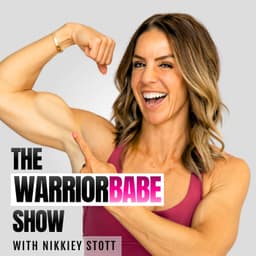
Episode 408
Keeps playing while you browse the site.
Chapters
In this episode
Creatine is the most researched supplement on the market, and the women who stand to gain the most from it are the ones least likely to take it. In this solo episode of The WarriorBabe Show, Nikkiey Stott explains what creatine actually is: a naturally occurring compound your body already makes from amino acids, also found in red meat and fish, that your muscles use for fast energy during heavy, high-effort lifting. It is not a steroid, not a hormone and not artificial.
Nikkiey works through the four myths that keep women over 40 away from it: that it makes you bulky, that it's only for men and bodybuilders, that it's only about performance, and that you have to cycle off it. She explains why women, older adults and people who eat less red meat tend to start with lower creatine levels and have more room to benefit. She also shares her own experience with brain fog and fatigue during a difficult health stretch, and why she now takes creatine every day for brain energy, bone health support and mood as well as training.
She closes with the practical part: no loading phase, 3 to 5 grams of creatine monohydrate every single day, including rest days, and no cycling. Pair it with progressive strength training and enough protein, give it 14 to 21 days of consistency, and let the basics do their work.
Key takeaways
- Creatine is not a steroid, hormone or artificial substance; your body makes it in the liver and kidneys from amino acids, and it is naturally found in red meat and fish.
- A 2 to 4 pound scale increase in the first week or two is water being pulled inside the muscle cells, not fat, and Nikkiey calls it a positive adaptation.
- Skip the loading phase, because Nikkiey says most bloating and digestive issues from creatine come from taking very high doses in the first week.
- Take 3 to 5 grams of creatine monohydrate every day, including non-training days, to keep your muscles saturated.
- You do not need to cycle off creatine; Nikkiey points to studies running out to five years showing no adverse effects in healthy individuals.
- Women, older adults and people who eat little red meat or are vegetarian tend to have lower baseline creatine levels, so they have more room to benefit.
- Take it consistently for 14 to 21 days before judging whether it is working.
- Creatine works best alongside the basics: progressive strength training and adequate protein intake.
Worth sharing
Word for word from this episode. Send one to a friend who needs to hear it.
Questions answered
Will creatine make women bulky?
No. Nikkiey explains that creatine pulls water inside the muscle cells, which can add 2 to 4 pounds on the scale in the first week or two and make muscles look slightly fuller, but that is hydration of muscle tissue, not fat or bulk.
How much creatine should a woman over 40 take?
Nikkiey recommends 3 to 5 grams of creatine monohydrate per day, every day, not just on training days. She takes 5 grams every morning stirred into her coffee.
Do I need to do a creatine loading phase?
No. Nikkiey says the old protocol of around 20 grams a day for a week isn't needed and often causes GI discomfort, bloating and water retention; a steady daily dose is enough.
Do you need to cycle off creatine?
According to the episode, there is no research supporting the need to cycle creatine, and your body's own production doesn't shut down in a way that requires it. Nikkiey notes studies going out five years show no adverse effects in healthy individuals.
Why might women benefit from creatine more than men?
Nikkiey explains that young men tend to eat more red meat and have higher baseline creatine levels, while women, older adults and vegetarians tend to start lower and have more room to benefit from supplementing.
Can creatine help with brain fog in perimenopause?
Nikkiey shares that creatine helped her with clarity and energy during a period of brain fog and fatigue, and explains that the brain uses creatine for energy the same way muscles do. She says studies show improvements in memory, processing speed and executive function, and suggests giving it 14 to 21 days of consistent use.
Full transcript
Nikkiey: Creatine for women over 35 or 40 is not hype. It is the most researched supplement in existence, with consistent evidence for muscle preservation, for training performance, for bone health, and for cognitive function. All of which are directly relevant to the body and the life you're building after 35 or 40 years old.
What's going on, everybody? Hey you guys, welcome back to The WarriorBabe Show with your host, Nikkiey Stott. Today we are talking about a supplement that has more research behind it than anything else on the market, and that most women over 40 have either never tried or stopped taking because they feel like it's only for bodybuilders, or it made them bloated, or maybe it's just not really for them, right? It's kind of in this gray area for a lot of women, and that supplement is creatine.
What I want to do in this episode is flip every myth that you've heard about it, because the women who need creatine most are not these 20-year-old, 25-year-old men at the gym. They are you: women over 40, women over 35, in perimenopause, postmenopause, trying to build and preserve lean muscle, protect their brain, maintain their strength, and get the most out of every single training session that you do.
So today I'm going to go through exactly what creatine is, what it actually does, what it does not do, who should be taking it, and how to actually take it correctly. Okay, so let's dive in and flip some of these myths that are out there.
First and foremost, let me give a clean definition of what it actually is, because there's a lot of confusion around creatine, and it usually comes from not actually understanding what it does.
Creatine is not a steroid. It is not a hormone. It is not artificial. It is a naturally occurring compound that your body produces on its own. It's primarily produced in your liver and your kidneys, and it's produced from amino acids. It is also naturally found in red meat and fish. Anything in the animal kingdom that has a mom and a dad, it's naturally in those animals.
Your body uses it to produce ATP, which is the primary energy currency that your muscles use during high-intensity, high-effort workouts. In a simpler version: when you lift something heavy, your muscles need energy fast, faster than your aerobic system can produce it. Creatine is the immediate energy reserve that your muscles reach for in those first few seconds of intense effort.
So the more creatine your muscle has stored, the more of that immediate energy is available, which means you're able to pump out more reps. You're able to challenge yourself with more weight. You're able to have more training output, more training stimulus, and more muscle adaptation over time. Supplementing with creatine saturates your muscles with more creatine than diet and natural production alone can provide. So you are not introducing something foreign to your body. You are just topping up something that your body already makes and uses.
Does that make sense? Your body already produces this. You're just giving your body a little bit more of it. You're saturating your muscles to be able to do more of the things you're already doing, just with more immediate energy. And this is why creatine is the most studied sports supplement in history, with thousands of peer-reviewed studies across decades of research consistently showing the same thing: that it works, that it's safe, and that it works especially well for the population most likely to be deficient in it, which includes us women, older adults, and people who do not eat significant amounts of red meat.
Okay, so that's the definition. Now let me go through these myths one by one, because these are the reasons why most women are not taking creatine, and most of them are wrong.
The first myth is that creatine makes you bulky. This is the one I hear most often, and it's based on a misunderstanding of what the supplement actually does. We've already talked through what creatine does, right? It also causes your muscles to pull in more water, specifically intracellular water, water that is inside the muscle cell.
This can cause a small initial increase on the scale, typically anywhere from two to four pounds in the first week or two. It can cause you to look a little softer, and it can cause your muscles to look slightly fuller. And this is the thing: because you look softer, you're seeing the weight go up on the scale, and your muscles look slightly fuller, some women are like, oh, this is just making me gain fat. But it's not. It is hydration of muscle tissue, which is actually a very positive adaptation of this supplement.
Fuller muscles mean you're able to be more defined, not bigger. And the water retention from creatine is intramuscular, inside the cells. It's not subcutaneous. It's not underneath your skin. It's inside the muscle tissue. So if you feel like you're seeing soft water under the skin that makes you feel a little more bloated, or if you're experiencing significant bloating from creatine, most likely the culprit was the loading phase, where you take very high doses of creatine the first week. You don't need to do that. It's not recommended for women to do that. I'll talk about this towards the end of the podcast, but there are specific ways you can just take a steady dose every single day. So if you've ever felt like, from taking creatine, your digestion is off or you feel bloated, it's probably because you were told to load 10 grams twice a day and then do X, Y, and Z after that.
You don't have to do that. Okay? So, debunking that myth: creatine will not make you bulky.
Another myth is that creatine is just for people in the bodybuilding world, and it's just for men. The research on creatine in women is so consistent, and it shows the same benefits across every population studied, including older women. There have been studies showing that women and older adults see proportionately greater benefits from creatine supplementation than young men. The thing is, young men tend to consume more red meat and have a higher baseline creatine level, whereas women eat less red meat. If you are vegetarian, this is a supplement I would highly recommend that you take.
If you're eating less red meat or you are vegetarian, and women over 40 tend to have a lower baseline muscle creatine level, you therefore have more room to benefit from supplementation. So it is not just for men, and it's not just for bodybuilders. There's so much research out there that debunks that.
Hey, while you're listening, if you're getting value from this episode, take a moment to tap that review button or share this podcast with a friend. It's a small gesture that goes a long way in helping more women find their way to feeling stronger and more confident in their skin. I appreciate you so much for taking the time to support this show.
There's another myth that creatine is only for performance and has no health benefits. That is not true. This one is significantly outdated, in my opinion. The research on creatine's benefits beyond athletic performance has dramatically expanded over the last decade.
The one I will stand by the most, because I personally take creatine on a daily basis, is what it's done for me. I've shared with you guys, and I'm probably going to do an update podcast soon, but about a year and a half ago I was struggling pretty badly with some health struggles. I was experiencing brain fog and extreme fatigue. When I started taking creatine, I noticed clarity, more energy, and more brain power, because creatine supports your brain health.
Your brain uses creatine for energy the same way your muscles do. There have been studies that show creatine supplementation improves cognitive performance, specifically memory, processing speed, and executive function, particularly in older adults and in conditions of sleep deprivation or mental fatigue. It's been a huge uptick in helping people in this category and improving all of those areas I just mentioned.
So for women navigating the brain fog I was just describing, which also very often accompanies perimenopause, this is directly relevant. Creatine also supports bone health. There's so much research suggesting that creatine supplementation combined with resistance training has a positive effect on bone mineral density, which is critical for women who are post-menopause, when bone loss accelerates.
So not only does it help with your brain, it helps with your bones. And it also helps with your mood. That's one of the things I've drastically noticed by taking creatine on a consistent basis. What I was going through last year was hard. I'm so happy to say I'm on the other side of it, but it was a scary place. There were parts of me that I didn't even recognize. There were parts of my body that were starting to regress, all because of things that were deficient when I got my blood work done.
I was also at that age where I need to be very aware of what I am putting into my body and how I am helping my body be strong for the long term. Now it's not just nutrition and workouts. It's supplementation, and progesterone, and NAD, and the things I take on the side, glutathione and other things that help support the overall aspects of my body.
But I'm saying this: it helps support your mood. There have been many studies finding that when women supplement with creatine, it significantly reduces symptoms of depression. That's because its primary role in the brain is energy metabolism, and that is directly correlated with this mood category, right? So it helps your mood.
It helps bone health. It helps brain health. So it's not just, oh, I take creatine because I lift, or I take it because I'm an athlete and I need it. No, it has so many other health benefits.
The last myth is that you have to cycle off creatine. You do not need to cycle off creatine. There's no research that supports the need to cycle creatine. Your body's natural creatine production does not shut down from supplementation in a way that requires cycling.
If you're taking creatine for long-term use, there are studies going out five years that show no adverse effects in healthy individuals. So you can just take it continuously. You don't need to cycle on and off it. That's also where people get the idea that it's a steroid, because people cycle on and off those. You don't have to do that with creatine. So that's myth number four: you don't have to cycle off creatine.
So, it is not just for performance; it has other health benefits. It's not just for men and bodybuilders. And it's not going to make you bulky. Those are four myths completely debunked.
But what I also want to spend time on here is connecting the dots: why women who are 35 and older need this supplement. The general case for creatine is strong, but the case for women 35 and older is so much stronger.
After 40, two things are happening simultaneously that creatine directly addresses. The first is that muscle is harder to build and easier to lose. If you don't know, estrogen starts to decline, anabolic resistance happens, and there's a reduction in growth hormone. All of it makes muscle protein synthesis less efficient in your body. Creatine does not replace those hormones, but it does increase the training output that drives the muscle-building signal. Doing more reps at higher weights over time, which is what creatine helps produce, means you have a stronger stimulus, which means more adaptation, which means more muscle is preserved and built despite all of these hormonal changes. Okay, so that's the first one.
The second one is your brain function. Your cognitive function is affected by the same hormonal changes: the brain fog, the memory issues, the processing slowdowns that so many of us experience. This was me last year. I was like, what is happening? I take care of myself. I work out. I eat well. But these things are still happening mentally, and I feel so off.
I'll do a podcast update, but it just felt like I wasn't me. And I don't want any woman to ever feel that way. When I started doing this and other things, other supplementation, it helped dramatically. Creatine's role in brain energy production makes it one of the most evidence-backed supplements available for cognitive support during this transition that we as women go through and face.
And it doesn't require a prescription. You can just start taking creatine, and you're going to see an uptick. I promise you. You've got to take it consistently to see it. I won't say you're going to see it the first week. I would say take it consistently for 14 to 21 days and you will see some type of improvement. That combination of muscle preservation, training performance, bone health support, and cognitive function makes creatine arguably the single most important supplement for women over 40 who are strength training.
It's not just a maybe. It's a strong yes, based on all of the available evidence.
Okay, so for the practical side of taking the supplement: there's no loading phase. You don't have to do the old protocol of 20 grams per day for a week. It gets you feeling it faster, but it also causes GI discomfort and makes you hold on to water. You don't need to do that.
All you need to do, dosing-wise, is three to five grams per day, every day. Not just on training days. Do it every day, because you are maintaining muscle saturation. Every day, seven days a week, that's what I do. I take five grams every morning. I put it in my coffee, I put my creamer in my coffee, and I use my little stirrer and stir it all together. Three to five grams is the consistent daily maintenance dose that keeps your muscles topped up.
That's what I highly recommend, guys: take it consistently, not just on your training days, but every day.
All right. So the verdict, all in all, with this episode: creatine for women over 35 or 40 is not hype. It is the most researched supplement in existence, with consistent evidence for muscle preservation, for training performance, for bone health, and for cognitive function. All of which are directly relevant to the body and the life you're building after 35 or 40 years old.
Okay. Three to five grams of creatine monohydrate per day, every day. No loading phase, no cycling, just consistency. It's a simple addition to your routine with some of the most significant returns, especially when paired with progressive strength training and the protein intake we talk about every single week. Add this to strength training and protein. If you just do some of these basics consistently, you will see some type of progress, guys.
And if you want to go deeper on the complete nutrition strategy, the complete training strategy, and how to make all of this work together, every Tuesday, Thursday, and Sunday we do live trainings for free. You can use the link in the show notes below to register.
All right. I love you guys. I hope this episode was helpful. If it was, I haven't asked this in a while, but I ask that you leave a review. If you haven't left a review yet for this podcast, it takes just 30 seconds. And if you haven't shared this with a friend, I ask that you share it with somebody close to you, a family member or a coworker. Thanks, guys. I will see you in the next episode.
One small favor to ask: if this episode brought you value or sparked something in you, take just a moment to hit that review button. Your rating and review make all the difference, helping more women discover the tools they need to transform their fitness and their confidence. It takes less than a minute, but it can change the path of someone else's journey. Thank you so much for leaving that review. I appreciate you so much.
Listen next
All episodes → 21 min
Should Women Over 40 Take Creatine? Pros and Cons
Episode 192 · Sep 23, 2024
 35 min
How to Balance Hormones With Nutrition for Fat Loss
Episode 172 · Jul 15, 2024
 29 min
Strength Training for Strong Bones During Menopause
Episode 65 · Jun 7, 2023
Best of Supplements & Creatine
All 16 → 1 hr 3 min
Why a 1200-Calorie Diet Fails Women Over 40
With Dr. Stacy Sims
 20 min
Which Workout Supplements Are Actually Worth Taking?
Episode 45 · Apr 21, 2023
 27 min
How to Quit Caffeine: Withdrawal, Benefits and Tips
Episode 157 · May 20, 2024