
Answered in 4 episodes
Can I strength train after a knee or hip replacement?
Answered by Nikkiey Stott and her guests · Updated
The short answer
Yes, according to several women on The WarriorBabe Show who did it. Johanna lifts three days a week after two total knee replacements and says she has no programming limitations. Peggy started about four to five months after her surgeries with one modified session a week. Follow your surgeon's guidance and modify every movement.
Hear it from the show
Tap play to start right where it's answered. It keeps playing while you browse.
Johanna on lifting after two knee replacements with no programming limitations
Plays from 25:57 · Ep. 336: Weight Loss at 62 After Menopause and Knee Replacements
Peggy, 70, on recovering from knee and hip replacements and her doctors filming her
Plays from 18:13 · Ep. 321: Can You Build Muscle at 70? One Woman's Transformation
Jean on her coach's exercises after hip replacement and a stair-filled trip to France
Plays from 25:40 · Ep. 226: Can You Lose Weight in Your 70s? Jean's 55-Pound Story
Lona on training through two surgeries with modifications and a stronger back
Plays from 22:00 · Ep. 277: Losing 50 Pounds After Menopause by Eating More Food
The full answer
The women on The WarriorBabe Show describe a gradual start, not a reckless one. Peggy, featured on Ep. 321 as she rebuilt muscle at 70, joined WarriorBabe about four to five months after her knee and hip replacements. She modified every workout and began with one session a week. Early on she couldn't get off the floor, so she used an exercise ball for her flies. By her six-month checkups, both of her doctors asked to video her. Her knee bends past 120 degrees, and she can get up off the floor without holding onto a chair.
Strength before surgery seems to help too. On Ep. 226, Jean explains that she had been working to strengthen the leg she was favoring, and she had lost weight before her hip replacement. Her surgeon restricted her activity at first. Her coach gave her exercises she could do within those limits. Two months after surgery, she climbed stairs throughout a two-week pilgrimage in France.
The long view is encouraging. On Ep. 336, Johanna is 62 and has had two total knee replacements, five years apart. Before WarriorBabe she was doing no weight training, and she believes the lack of muscle was part of what kept her from the weight she wanted. Now she trains lower body, upper body and full body each week, adds two Pilates days, and says her knees don't limit her programming. On Ep. 277, Lona talks about training through back surgery and another major surgery using modifications. She says her back is stronger today than it was before surgery. She points out that knees may ache more after 40, but that doesn't mean you can't modify a squat or lunge and still succeed.
These are personal stories, not medical clearance. Every woman here worked within her surgeon's restrictions. Work with your doctor or physical therapist on when to start and what to avoid, then build from there with modifications. A replaced joint doesn't mean you have to give up lifting. You need a plan that fits where you are now.
From The WarriorBabe Show with Nikkiey Stott. For education, not medical advice: talk to your doctor about your own health.
Women also ask
More questions →
Women's Health & Aging
Does strength training help bone density in menopause?
Yes. Nikkiey explains that strength training puts stress on your bones, which triggers them to rebuild stronger and denser, raising bone mineral density and lowering osteoporosis risk as estrogen drops in menopause. On the show, she and guest Sal Di Stefano agree that walking and cardio don't come close to resistance training for bone.
Read the answer →

Women's Health & Aging
Does lifting weights help your mental health?
Yes. On The WarriorBabe Show, Nikkiey explains that lifting gives the stress your body carries somewhere to go, triggers endorphins she calls the brain's natural antidepressants, and builds confidence every time you lift heavier. She also cautions that not every way of exercising is good for your mind, especially when your training is driven by guilt.
Read the answer →

Women's Health & Aging
What should I do if my doctor dismisses my symptoms?
Don't accept "it's just aging" or "it's stress" without data. Nikkiey says to push back politely and firmly, arrive with a weekly symptom log and a list of questions and tests, and remember you can get a second opinion or change doctors if yours won't engage.
Read the answer →
Watch the full episodes
More episodes →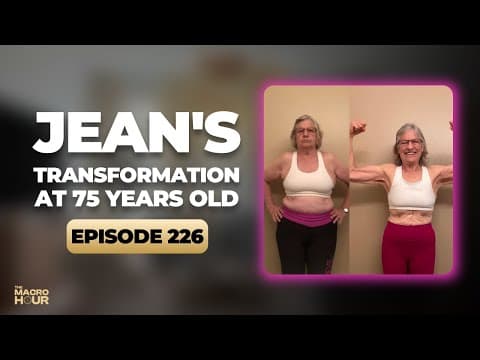 45 min
Can You Lose Weight in Your 70s? Jean's 55-Pound Story
Episode 226 · Jan 20, 2025
 36 min
Can You Build Muscle at 70? One Woman's Transformation
Episode 321 · Dec 22, 2025
 34 min
Weight Loss at 62 After Menopause and Knee Replacements
Episode 336 · Feb 13, 2026